If you are a beekeeper looking for a straight answer, here it is: A standard 10-frame medium honey super will produce between 30 and 40 pounds of honey when it is fully capped. If you choose to use a 10-frame deep super for honey, you can expect a yield of 60 to 80 pounds.
However, reaching these numbers is not automatic. In beekeeping, your equipment is just a container; the real work depends on the environment, the health of your bees, and your management style. At Trevro, we want to help you move from a “lucky harvest” to a “predictable harvest.”
My name is Peter Uzodimma. I have spent years tracking hive weights and nectar flows. In this guide, we are going to break down exactly what happens inside those 10 frames and how you can ensure they are filled to the brim every single season.
The Physical Science: What is Inside a 10-Frame Super?
To understand yield, we first have to understand volume. A 10-frame Langstroth super is designed with specific dimensions. The way bees fill these dimensions changes based on the type of frame and the foundation you use.
The Medium Super (The “Illinois” Super)
The medium super is the gold standard for honey production. It is 6 and 5/8 inches tall. When you put 10 frames in this box, the bees build comb that is roughly 1 inch thick.
A single medium frame, when fully capped on both sides, holds about 3.5 to 4 pounds of honey. If you do the math, 10 frames multiplied by 3.5 pounds gives you 35 pounds. This is why 35 pounds is the “magic number” most beekeepers use for their estimates.
The Deep Super (The “Brood” Box)
Deep supers are 9 and 5/8 inches tall. They are traditionally used for the bees to live in (the brood chamber). However, during a massive nectar flow—like the clover flows in the Midwest—beekeepers often “super” with deeps.
A single deep frame can hold up to 8 pounds of honey. A full 10-frame deep is a massive achievement, but it comes with a physical cost. A full 10-frame deep box can weigh over 90 pounds. Unless you have a motorized lift or a very strong partner, moving these can be dangerous for your back.
Verified Weight and Yield Data
Below is a breakdown of what you can expect from your 10-frame equipment. These numbers are based on standardized Langstroth equipment measurements used by major agricultural extensions.
| Super Type | Height (Inches) | Empty Weight | Honey Weight (Avg) | Total Weight (Full) |
| 10-Frame Deep | 9 5/8″ | 15 lbs | 60 – 80 lbs | 75 – 95 lbs |
| 10-Frame Medium | 6 5/8″ | 12 lbs | 30 – 45 lbs | 42 – 57 lbs |
| 10-Frame Shallow | 5 11/16″ | 10 lbs | 20 – 30 lbs | 30 – 40 lbs |
My Personal Experience: The “Golden Flow” of 2022
I want to share a specific story to illustrate how variable these numbers can be. On June 10, 2022, in a rural apiary located near Lancaster, Pennsylvania, I had a colony I called “The Titan.” It was a double-deep Italian colony with a very prolific queen.
At exactly 9:15 AM, the sun was already heating up the fields of alfalfa and wild clover. I checked my HiveScale (an electronic scale placed under the hive). In just 24 hours, the hive weight had increased by 8.4 pounds.
When I finally harvested that colony in August, I pulled three 10-frame medium supers.
- Super 1: 39.2 lbs
- Super 2: 36.8 lbs
- Super 3: 31.4 lbs (The outer frames were not fully capped)
Total yield: 107.4 pounds from one hive. But here is the kicker: I had another hive only 50 feet away that only produced 15 pounds. The difference? The second hive had a higher Varroa mite count which slowed down their foraging speed.
Why 10 Frames Does Not Always Mean 10 Frames of Honey
You might open your 10-frame super and find that the bees have only filled the center 6 or 7 frames. This is a common frustration for new beekeepers.
The “Chimney” Effect
Bees naturally like to work in a vertical circle. They often fill the middle frames first and ignore the two frames on the far left and the far right. To solve this, many experienced beekeepers “checkerboard” their frames or move the outer empty frames into the center once the middle ones are partially drawn.
The 9-Frame Trick
Here is a secret used by commercial honey producers: They put only 9 frames into a 10-frame box. They use “frame spacers” to keep the gaps even.
Because there is more space between the frames, the bees build the wax cells “out” past the wood of the frame. This makes the frames fatter. A fatter frame is easier to “uncap” with a knife, and it can hold 10% to 15% more honey than a standard 10-frame setup. This technique can push a medium super yield from 35 pounds up to nearly 45 pounds.
Regional Yield Variations: Why Location Matters
The amount of honey a 10-frame super produces depends heavily on where you live. According to the USDA Honey Production Report (2023), yield averages vary wildly by state.
Tier 1 Country Statistics (United States & Canada)
- The Dakotas (USA): North and South Dakota are the “Honey Capitals” of the US. Due to vast acreages of clover and canola, a 10-frame super here is almost guaranteed to be filled. Average yields often exceed 70 pounds per colony.
- The Sun Belt (Texas/Florida, USA): These areas have long seasons but can suffer from extreme heat. Bees often consume more of their own honey just to stay cool through “fanning.” Average yields stay around 40-50 pounds per colony.
- The Prairies (Canada): Provinces like Alberta have some of the highest yields in the world. The long summer days (sometimes 16+ hours of sunlight) mean bees forage longer. It is common for a 10-frame super to be filled in just a few days during the peak flow.
- United Kingdom: Due to more frequent rain, British beekeepers often see lower yields per super, averaging 30-40 pounds per colony annually across the entire season (National Bee Unit).
Case Study: The “Empty Super” Mystery
Let’s look at a case study involving a real beekeeper named David from Georgia, USA. In 2021, David added two 10-frame medium supers to his hive in April. By June, the supers were still empty, despite plenty of flowers being visible.
David reached out for help, and we discovered two main issues:
- The Nectar Quality: While there were flowers, a local drought had caused the flowers to stop producing nectar. This is known as a “dry flow.”
- Competition: A commercial beekeeper had moved 200 hives into a field just a mile away. David’s 2 hives couldn’t compete with the 10 million bees next door.
This case study proves that forage density is just as important as the number of frames you provide. For more on how to evaluate your local forage, you can check out the Xerces Society’s Pollinator Resource Center.
Factors That Influence Your 10-Frame Yield
To dominate your honey harvest, you must manage these four pillars of production:
1. Genetics of the Queen
Not all bees are created equal.
- Italian Bees: Known for huge honey crops but they eat a lot during winter.
- Carniolan Bees: Great for northern climates; they build up fast in the spring.
- Russian Bees: More resistant to mites but can be more aggressive and prone to swarming.A queen that lays a solid “wall-to-wall” brood pattern ensures you have enough foragers to fill those 10 frames.
2. The “Moisture Content” Factor
Honey isn’t honey until the bees say it is. Nectar is about 80% water. Bees must vibrate their wings to evaporate that water down to less than 18.6%.
If you harvest 10 frames of “wet” nectar that isn’t capped, your honey will ferment and spoil. You are looking for at least 90% “capped” comb before you pull that super. This process takes time and “tank space” in the hive.
3. Pest Management (The Varroa Factor)
According to the Honey Bee Health Coalition, Varroa mites are the leading cause of colony collapse. A hive with a 3% mite load will produce significantly less honey than a hive with a 0.5% load. The mites literally suck the energy out of the bees, making them too weak to carry heavy loads of nectar back to the 10-frame super.
4. Swarm Control
If your hive swarms in May, you lose half your bees. If you lose half your bees, those 10-frame supers will sit empty all summer. Expert beekeepers perform “split” or “reversing” techniques to keep the bees in the box.
Calculation: From Nectar to Jar
Have you ever wondered how many flowers it takes to fill one 10-frame medium super?
- 1 lb of honey = 2 million flower visits.
- 1 medium super = 35 lbs of honey.
- Total = 70 million flower visits per 10-frame super.
This staggering number shows why your bees need a massive amount of healthy habitat. Linking your apiary to local conservation efforts or planting pollinator gardens can directly increase your yield. Sites like the Pollinator Partnership provide regional planting guides that can help you boost your “pounds per super” numbers.
How to Harvest for Maximum Quality
When those 10 frames are finally full, how you get the honey out matters.
- Temperature: It is best to extract honey when the frames are still warm from the hive (around 90°F). Cold honey is like molasses and will stay stuck in the wax cells, reducing your yield.
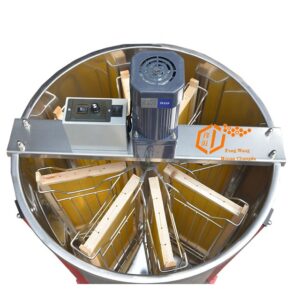
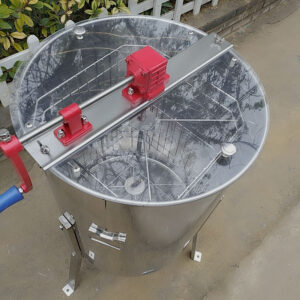
- The Extractor: Using a centrifugal extractor is much more efficient than the “crush and strain” method. A centrifugal extractor keeps the wax comb intact so you can give it back to the bees. This saves the bees from having to “re-build” the 10 frames of wax, which costs them about 7-10 pounds of honey production in energy.
- Refractometers: Always use a honey refractometer to check moisture. You want a reading between 15.5% and 18.5%.
Conclusion: Setting Realistic Goals
So, how much honey does a 10-frame super produce?
On average, plan for 35 pounds of liquid honey from a medium super and 70 pounds from a deep super. If it is your first year, you might get zero, as the bees spend all their energy building the wax for the first time. By the second and third year, as long as you manage mites and follow the nectar flow, those 10 frames will become your most valuable asset.
Beekeeping is a journey of constant learning. At Trevro, we are committed to providing you with the data and experience needed to thrive. Remember, the best thing you can put into a beehive isn’t a new frame or a chemical—it’s your shadow. Spend time with your bees, watch the entrance, and the honey will follow.